Calimport was the sprawling capital city of the country of Calimshan.[3][2][20] For most of its existence, it was by far the largest city in all of Faerûn.[7] It was the long-time home of the assassin Artemis Entreri, known for his longstanding feud with Drizzt Do'Urden.[21]
Geography
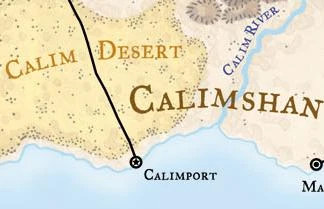

A map showing the location of Calimport.
Calimport was between the Calim Desert to the north and the Shining Sea to the south. It rested at the mouth of the Calim River at the very southern end of the Trade Way.[3] To the west of Calimport, the coast extended south, forming a natural harbor for the city.[22]
The metropolis was a huge place, measuring almost six miles from east to west and three miles from the coastline to the northern border.[1]
Architecture
Because Calimport had such a long history, including at least twelve times the city had been almost completely destroyed by fire or other calamity, most of the older buildings of the city had been rebuilt or merged into newer ones. One could find ancient byways, rooms, or other structures integrated into others.[19]
Defenses
Perhaps surprisingly, since the Seventh Age of Calimshan, the city did not have a full wall around it. Even so, the city would have been very difficult to place under siege due to its massive size. Moreover, because of its walled sabbans and drudachs—as described below—it would be next to impossible to march an army deep into Calimport.[1] As for its harbor, the city had been protected for millennia by its sturdy Seawall.[22]
Organization
Drudachs/Sabbans/Wards
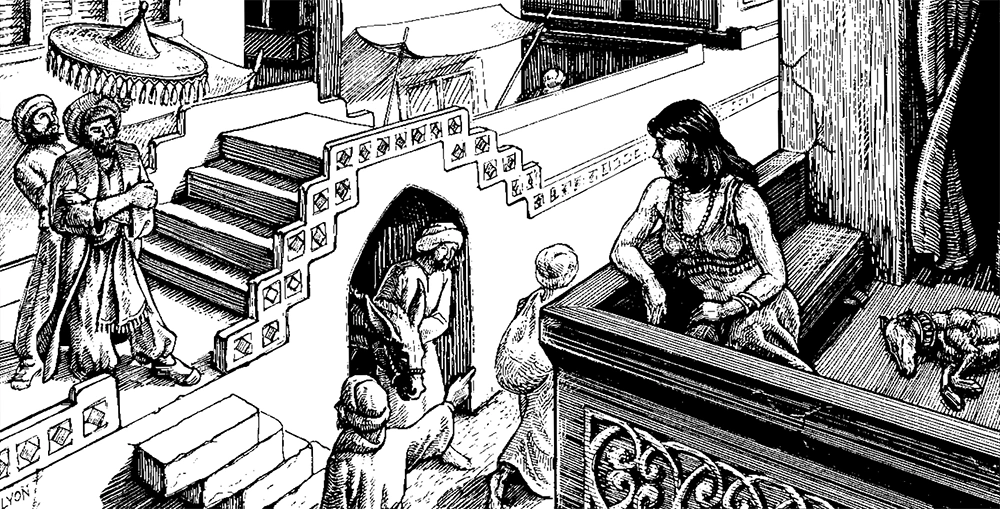

A drudach wall in the city of Calimport.
Calimport was built using the "drudach system", an interlocking series of small brick-walled neighborhoods.[23] All drudachs were organized into groups of two to five, called sabbans, which in turn were grouped into wards. Calimport was subdivided into 17 wards, 53 sabbans,[note 2] and 166 drudachs.[1] Each sabban worked as a self-sufficient town—it has its own water supplies, guards, markets, residences, and so on.[23] The condition of drudach and sabban boundaries varied greatly between richer and poorer regions of the city. In upper-class regions, boundary walls might be improved by intricate stone work or glazing; in poorer areas, the drudach walls had been trampled to mud and the sabban walls were little more than stepping stones. In these lower-class areas, plinths were used instead to indicate the boundaries.[19]
In the three richest, central wards—Palace Ward, Jewel Ward, and Grand Ward—the ground level of the city had been elevated. Streets and courtyards were raised off the ground by stone and wooden supports and archways. Stairs led down to the original ground level, where slaves and the poor still moved about. The area below these "risen sabbans" was known as the "Upper Muzad".[24]


A map of the city of Calimport in 1501 DR. Hovering over the map will reveal main wards and features. Clicking will link to the article for that location.
The Pasha's Sabban, housing the syl-pasha's palace, was located in the center of Palace Ward but was not considered a part of that ward.[24]
The Undercity
The city contained many springs and wells to provide water for the population. These were heavily guarded by amlakkar and members of the Guild Arcane to prevent against poisonings.[25]
Calimport's sewer system was vast. It was constructed in the Seventh Age of Calimshan and emptied into the ocean south of the city. The primary tunnels were 30 feet (9.1 meters) wide with 5‑foot (1.5‑meter) walkways on each side. Stepping stones over the sewage were located every 50 yards of length. Secondary tunnels were half as wide, with a pathway only on one side. There were also many other pipes ranging in diameter from 1 to 8 feet (0.3 to 2.4 meters).[25]
More than wells, sewers, and waterways, subterranean Calimport functioned as its own part of the city. It contained streets, buildings, and ancient, forgotten areas[19] and was collectively known as the Muzhajaarnadah, the "city of shadow", or simply the "Muzad".[25] The Muzad was anywhere from 6 feet (1.8 meters) to nearly 0.5 miles (800 meters) deep.[19] It was formed over the millennia from all the times that Calimport was rebuilt; rather than clear rubble, newer sections of the city were often rebuilt atop the old ones.[25]
The Port
The port of the city was the largest in all of Faerûn. Massive, magical sea walls were in place to protect the docks, which could contain as many as 600 private vessels and an additional 30 military vessels. These sea walls were ancient, constructed during the Calim Empire by marid and dao. They were 150 feet (46 meters) wide at their bases 200 feet (61 meters) below the surface. They rose 20 feet (6.1 meters) above the surface during calm waters and were 30 ft (9.1 m) thick at their peaks.[22]
The harbor itself was extremely deep, as the shore incline at Calimport was steep.[22]
Government
Throughout its ancient history, Calimport had been ruled by a wide assortment of leaders. Since the Seventh Age of Calimshan, the ruler of Calimport has been called the syl-pasha.[26][27] Most syl-pashas, however, ruled in name only, the true power being held by the syl-pasha's vizars. Immediately below the syl-pasha were the sultans, the princes who ruled over the wards. The ruler of each sabban was called a "sabbalad", and each drudach was directed by a druzir, the bottom of Calimport's pyramidal administration.[28]
In 1359 DR, Ralan el Pesarkhal staged a coup that gave him full control of Calimport. The syl-pasha responded to no vizar or council; he was the supreme ruler.[28]
Armed Forces
As in other Calishite cities, Calimport's domestic security forces were the amlakkar, the city watch, whose duties were to see to the peace and protection of the drudach to which they were assigned.[29]
In 1370 DR, the city maintained 12,000 amlakkar and their officers, which was twice the usual amount one would find in other cities of Calimshan. This number, however, proved insufficient to deal with massive horde of people living in the city.[7]
The syl-pasha's army included 7,500 soldiers stationed in the city, and the navy included 2,000 sailors and naval workers.[7]
Rich nobles, including the syl-pasha, also employed large numbers of armed guards. Approximately, 15,000 such warriors were present in the city, in addition to the official troops.[7]
Trade
One could find anything they wanted in Calimport, if they were willing to pay a high enough price. Calimport had more to offer in sales than even Waterdeep.[7]
The black market was alive and well in Calimport. The amlakkar tended to turn a blind eye to it.[7]
The city was a well-known spelljamming port, the second-largest in Faerûn after Waterdeep. Similarly to Waterdeep, spelljamming vessels were required to land on the water several miles from the city and make their final approach by sea. The reason for this law was that items in trade that came from wildspace were greatly sought after by the local population and could fetch much higher prices than equivalent local goods. This rule was ruthlessly enforced by the merchants' guilds; trespassers would either be found dead the next day or simply disappear, their spelljammers auctioned to the highest bidder.[12]
Spelljamming merchants enjoyed the city's exports of magic items, exotic spices, alchemical supplies, silk, gems, and horses, as well as the locally produced and extremely popular trika, a sweet and strong wine made from palintrike. Calimport imported food products such as grains, fruits and vegetables, ale, and wine.[12]
History
The Calim Empire
Circa −7800 DR, the noble djinni lord, Calim, and his human and halfling slaves arrived in Calimshan, in the area where Calimport would later be founded, and formed the Calim Empire. The slaves built Calimport and were the first inhabitants of the city, forming the culture of Lord Calim.[13]
Approximately ten years after its founding, Calimport was razed by a flight of dragons. The city was rebuilt with genie magic within a year.[13]
The First Era of Skyfire, began around −6500 DR, as Calim warred against the efreeti Memnon. Their doom due to the intervention of the elves ended the Calim Empire and Calim's reign in Calimport.[14]
Coramshan
With Calim gone, the humans and the dwarves rebelled against the last of the djinn in Calimshan and by −6060 DR ousted the last of the djinn from Calim's realm, forming the kingdom of Coramshan. While the dwarves founded High Shanatar, the humans once again rebuilt Calimport.[30]
The First Age of Calimshan
Sometime around −5000 DR, Coramshan and the kingdom of Mir united to form the Empire of Calimshan. The bakkals of the First Age ruled from Calimport until the Sunset Plague in −3332 DR nearly annihilated the population of the city. It remained empty for nearly a century after.[14]
The Second Age of Calimshan
The Tavihr bakkal dynasty of the Second Age was assassinated in −2381 DR in a fire that also destroyed the western half of Calimport. This destruction was combined with a series of guild wars. When the Erehnir Dynasty took power shortly thereafter, they rebuilt the city again. The Erehnirs were the ones who introduced much of Calimport's religious imagery and artistic style, with the building of great temples and monuments, which would remain present well into the 14th century DR.[31][14]
The Third Age of Calimshan
Two-thirds of Calimport was destroyed again at the start of the Third Age of Calimshan when, in −1839 DR, Ylveraasahlisar the Rose Dragon conquered Calimport and sat herself on the throne of Calimshan. She ruled for over a hundred years until the humans rebelled once again by slaying the dragon in −1726 DR. The leader of the dragonslayers, Rafak el Cajaan became the new ruler of Calimport and Calimshan.[31][14]
Calimport, along with the Cajaan Dynasty, fell again in −1428 DR, this time to an army of beholders led by Qyraaptir the Bloodeye. Qyraaptir "sat" on the throne of Calimport for 26 years. At the end of his reign, fires were set to Calimport, in an attempt to drive him and the other beholders away. Calimport was the first Calishite city freed of the beholder tyranny.[32][14]
The war with the beholders continued until −1080 DR. By that time, Calimport was again the capital of all Calimshan, and a boost in trade saw the city to nearly double in size.[14]
The Third Age did not end well for Calimport, however; a series of plagues wiped out half its population of slaves and 80% of its total population. While never proven, it was suspected that the plagues were created by rival kingdom Jhaamdath.[32][33]
The Fourth Age of Calimshan
During the Fourth Age of Calimshan, drow slave raids in Calimshan were common, collectively being called the "Night Wars". In −691 DR, drow raided Calimport and destroyed the Caleph's Palace and slew the members of the Vihad Dynasty. Several decades later, the Calishite army was ordered by the syl-pasha to set fire to Calimport, where they held control of a quarter of the city, in hopes of driving the drow out. Finally, in −620 DR, the syl-pasha's trade negotiations with the drow succeeded, though it still took until −530 DR for the Night Wars to cease entirely.[33]
−446 DR saw another terrible tragedy to the city of Calimport, when a fire destroyed almost the entire Calishite armada stationed in the port and 70% of the city.[34]
Yet a third major conflagration was attempted in this age, yet it failed. It was intentionally set in −375 DR by Syl-Pasha Akkab el Evyrtaan in an attempt to control the Empire Plague, which had slain a third of Calimport's population by that time. The syl-pasha abandoned the city, and priests of Talona attempted to seize control. Few remained in the city except for rogues. The followers of Shar fought back, resulting in many violent deaths. When the plague ended in −370 DR, Akkab returned. He brutally killed many of the remaining population, seeking to remove any plague-carriers or the worshipers of Talona and Shar whom he considered traitors. Those who survived fled into the undercity.[34]
In −339 DR, the Fall of Netheril caused the destruction of two entire sabbans, when magic ceased temporarily. At least 7,000 people died from this destruction.[34]
Despite these disasters, by −227 DR, Calimport had grown to its largest size ever, with a population over 75,000. For the next 800 years, it was the largest port city in all of Faerûn.[34]
The Fifth Age of Calimshan
The Fifth Age began in −200 DR with the assassination of Syl-Pasha Kalil el Evyrtaan from thousands of viper bites. His successor, Asraf el Majizar, notably made Calimport into a more organized city with trade and workers' guilds.[34]
Asraf's son, Malik el Majizar, was a rare good ruler. His leadership nearly doubled the trade to Calimshan. Even so, he was assassinated in −188 DR. This began the Throne Wars. During this time, the ruler of Calimport no longer controlled all Calimshan, for the next two years saw a total of 39 different rulers take and lose the throne in Calimport. The Throne Fires, a series of seven separate burnings, were sparked during this time, and the flames consumed 43% of the population and nearly two-thirds of the city. At last, in −187 DR, Tasyn el Tarshaj from Manshaka took the throne and began to bring stability to the city and the kingdom again.[34]
The Age of Shoon
Only the first emperor of the Shoon Imperium ruled from Calimport, Akkabar el Shoon, from −77 DR to −2 DR. His successor, Qysar Amahl Shoon III moved the capital to Shoonach,[35] and Calimport became an almost-deserted city. The undercity, (nicknamed the "Muzad",) generated by dozens of fires and collapses, became more powerful than ever during this time.[36]
In 200 DR, rogue factions set fire to Calimport, killing 60% of the population and destroying the temples of Bane, Mystra, and Talona.[36]
Another great fire occurred near the end of the Imperium, when the current qysar, Shoon VII burned most of the Muzad and sewers in an attempt to root out all criminal activity from Calimport. This fire slaughtered nearly nine-tenths of all undercity dwellers.[36] Calimport would take more than three decades to rebuild itself.[26]
The Seventh Age of Calimshan
When Amahl Shoon VII was slain by King Strohm I of Tethyr in 450 DR, every city in Calimshan went into political upheaval. In Calimport, ultimately Fahd el Daosiin took the title of syl-pasha. Only seven years later, the new syl-pasha and his family were killed when the entire Pasha's Sabban was magically destroyed in an explosion that also set fire to the majority of western Calimport.[15]
By 533 DR, slave-soldiers known as mameluks led a revolution against the rulers of Calimport and were victorious. They took control, abolished slavery, and changed the capitol of Calimshan to Manshaka.[15]
The Port Fires of 733 DR destroyed the docks of Calimport. This was a ploy by the Rundeen to enact control over trade in the region.[15]
In 864 DR, deep below Calimport in a former drow temple, the Twisted Rune was founded by Rysellan the Dark. Within several decades, when some of the mameluks returned to Calimport in an attempt to reclaim power, the Twisted Rune manipulated events to place their agent, Bollus el Kahdan in power as syl-pasha. Through Bollus, the Rune planned the destruction by fire of much of the upper city, restoring a great deal of power to the Muzad.[37]
During this era, Calimport's massive sewer system was constructed.[25]
The Eighth Age of Calimshan
During the Rage of Dragons in the Year of the Dracorage, 1018 DR, Calimport and Keltar were attacked and obliterated by the dragon Sapphiraktar the Blue.[38]
Two centuries later, in the Year of the Black Horde, 1235 DR, an army of orcs known as the Black Horde conquered Calimshan, as well as most of the western realms, before the combined forces of Waterdeep, Silverymoon, and Baldur's Gate drove off the horde.[17]
Four decades of trade wars were responsible for the disintegration of Calimshan as a unified kingdom, as Calimport, Memnon, and Almraiven became independent city-states. In Calimport, el Djenispool family took the syl-pasha's seat.[17]
The Ninth Age of Calimshan
During the reign of the Djenispools, much of the power in Calimport was in the control of guilds, such as the one run by Pasha Pook,[39] and criminal organizations such as the Shadow Thieves.[40] A great storm devastated Calimport in 1345 DR, which was a fake memory implanted into the survivors by the Night Parade to disguise their evil festival.[41]
The Tenth Age of Calimshan
When the Time of Troubles came in 1358 DR, the underworld of Calimport was thrown into chaos, as the Bhaal Death eliminated many thieves and rogues. The Darkstalker Wars erupted at this time, and Ralan el Pesarkhal from Manshaka used this opportunity to begin his rise to power.[40] In 1359 DR, he had syl-pasha Rashid el Djenispool assassinated by one of his jhasinnar, and Ralan took the throne of Calimport.[18]
During the Nightcleansing of 1359 DR, the Harpers led by Myrmeen Lhal, Lord of Arabel, unmasked the Night Parade infestation in Calimport and interrupted another Festival of Renewal. Nearly all of the Night Paraders were destroyed by the raging town populace.[42]
Second Era of Skyfire
When Calim was freed from his imprisonment, so too was Lord Memnon. This led to the Second Era of Skyfire, with Calim retaking Calimport, while Lord Memnon would take the self-titled Memnon. In Calimport, the windsoul genasi took over and made all other races—including humans—slaves, forcing them to participate in gladiatorial games. Led by Marod el Arhapan, the windsoul genasi pledged themselves to the djinn. This led the djinn to view the genasi as children; the earthsoul genasi formed the low caste of the genasi hierarchy, and the firesoul genasi became outlaws for pledging themselves to Lord Memnon.[10]
Rise of the Genasi
In 1450 DR, the Second Era of Skyfire came to a close with both Calim and Lord Memnon disappearing, but the djinn of Calimport wished to bring Calim back to Calimport in order to invade both Memnon and Almraiven. The djinni Shahrokh took over as the vizier to Pasha Marod el Araphan. Marod began looking for his son, Cephas, in a plan hatched by Shahrokh to bring Calim back to the Prime Material Plane to start the Third Era of Skyfire. Cephas killed Marod, bringing an end to Shahrokh's plans. Shahrokh, however, began looking for a book that would free Calim. Sharokh's search for the book is currently ongoing, and it is unclear as of now if he has succeeded, failed or is still looking.[10]
Rumors & Legends
The great sea walls of Calimport, built by genies long ago, contained secret chambers, storing many treasures and riches. As of 1370 DR, only the Caleph Arcane of the city was aware of this.[22]
Notable Locations
Quarters
- Temple and Learning Quarter
- Located in the western part of the city and containing the Plaza of Divine Truth.[43]
- Market Quarter
- Located in the center of the city.[43]
- Dock Quarter
- Located south of the Market Quarter and comprising the southern part of the city.[43]
- Craft Quarter
- Located east of the Market Quarter.[43]
Taverns & Inns
- Tomnoddy's Inn: An inn located along the Trade Way in northern Calimport.[43]
- Coiled Snake:[44] An inexpensive inn located in the north of the Dock Quarter. Like many other Calimport inns, the rooms were hot, tiny, noisy, and infected with insects and rodents.[43]
- Spitting Camel:[44] Located in Eachid Drudach of Sholeh Sabban,[45] off of Rogue's Circle near Pasha Pook's Palace. This inn was safe and reasonably priced and was run by a nervous man.[43]
- Copper Ante: An gambling hall, festhall, and pipeweed den catering mainly to halflings and run by Dwahvel Tiggerwillies. The establishment was particularly known for its Thayan brown pipeweed and beautiful halfling ladies.[46] Dwahvel prided herself on keeping her place as private as possible, using magical wards to prevent unwanted audiences. [47]
- Two-Headed Mare: A gambling pub opened by a commoner whose horse had been transformed by the unstable magic of the Arrival. A wealthy man paid a large sum for the two-headed creature, which allowed the former owner to open a tavern, naming it after the sold mare to appease his daughter.[48]
Temples
- Temple of Old Night: Located beneath eastern Calimport, this subterranean complex was the oldest and proudest Sharran temple in Faerûn.[49]
Streets
- Rogues' Circle: A cul-de-sac north of Pasha Pook's palace in the Khanduq Ward.[43][45] Many iron grates that led into the sewers lined the street.[43]
- Avenue Paradiso: A street in the Dock Ward near the Copper Ante known for its black market, which specialized in pipeweed, stolen goods, and temporary companionship.[43]
- Trade Way: The end of the trade road running from Calimport all the way to Waterdeep. The road made it's way through the middle of the city and ended at the harbor.[43]
Guildhouses
- Pook's Palace: Former home to Pasha Pook, located in Sarkh Drudach of Sholeh Sabban[45] within walking distance of the Spitting Camel. This residence appeared to be a plain brown storehouse, but the interior revealed great wealth. A harem and the "Cells of Nine" torture chamber (eight cells housing hungry, wild lions and tigers around a single prison cell with just enough room for a prisoner to stand without being mauled) were some of the excesses of the palace.[43] After Pook's death in 1357 DR, the palace became run-down, and a former thief of Pook's, Nur el Esarn, lived there.[45]
- Pasha Basadoni's House: Located in the northern Market Quarter.[43] Later used as a front for Bregan D'aerthe.[47]
Other
- Harbor: The harbor formed the city's southern border and was cut off from the Shining Sea by several sea walls and was cut off from the city by wall. The shipyard was located on the eastern edge of the docks. The armada and armada barracks were located on the western edge of the docks.[43]
- Pasha's Palace: Located at the western edge of the city between the armada and Plaza of Divine Truth in the Temple and Learning Quarter.[43]
- Aurora's Emporium: an outlet that served as both a store and a trading post for agents to send their acquired goods back to the central warehouse.[50]
Inhabitants
More than nine out of ten inhabitants of the capital were humans. A few percent each were Halflings and half-orcs. This did not account for the millions of slaves also living in the city or for the many foreign visitors and merchants throughout the year. The population of the city could swell to as much as double during the spring and summer months when trade was at its peak. In the winter months, rich nobles would return from their cooler summer homes, increasing the summer population by a couple tens of thousands.[7]
Calimport included the only large population of free halflings in Calimshan.[3] (The majority of halflings in Calimshan were slaves, who worked in the countryside.)[51]
Religion
Calimport was truly a polytheistic society and was a major religious hub.[3] The city contained over 300 religious sites.[4] The most prominent religions were those of Bhaelros (Talos),[3][4] Shar, Shaundakul, and Waukeen.[4]
Notable inhabitants
- Artemis Entreri, master assassin [47]
- Pasha Pook, head of a thieves' guild [47]
- Pasha Basadoni, head of House Basadoni [47]
- Dwahvel Tiggerwillies, proprieter of the Copper Ante [47]
- Dondon Tiggerwillies, wererat locked in the Copper Ante [47][46]
- Rassiter, leader of the wererats [47]
- Sharlotta Vespers, former lieutenant of House Basadoni and lieutenant of Bregan D'aerthe in Calimport [52]
Trivia
Calimport was known in Tethyr for having roaches.[53]
Appendix
Notes
- ↑ According to census-taker Vizar Achmed el Imnt of Calimport, this figure was "altered ridiculously". It included all slaves and dependent rural families, whereas other population figures recorded here do not. (See: Steven E. Schend, Dale Donovan (September 1998). Empires of the Shining Sea. Edited by Julia Martin. (TSR, Inc.), p. 99. ISBN 0-7869-1237-5.)
- ↑ Empires of the Shining Sea claims 52 sabbans, but the Calimport sourcebook corrects this.
Gallery


Appearances
Novels & Short Stories
Video Games
Neverwinter Nights 2: Storm of Zehir &bull • Neverwinter Nights 2: Mysteries of Westgate
References
- ↑ 1.0 1.1 1.2 1.3 Steven E. Schend (October 1998). Calimport. (TSR, Inc), p. 4. ISBN 0-7869-1238-3.
- ↑ 2.0 2.1 2.2 2.3 Ed Greenwood, Sean K. Reynolds, Skip Williams, Rob Heinsoo (June 2001). Forgotten Realms Campaign Setting 3rd edition. (Wizards of the Coast), p. 156. ISBN 0-7869-1836-5.
- ↑ 3.0 3.1 3.2 3.3 3.4 3.5 3.6 3.7 Scott Haring (1988). Empires of the Sands. (TSR, Inc), pp. 54–56. ISBN 0-8803-8539-1.
- ↑ 4.0 4.1 4.2 4.3 4.4 4.5 Steven E. Schend, Dale Donovan (September 1998). Empires of the Shining Sea. Edited by Julia Martin. (TSR, Inc.), pp. 107–108. ISBN 0-7869-1237-5.
- ↑ 5.0 5.1 5.2 5.3 Steven E. Schend (October 1998). Calimport. (TSR, Inc), p. 3. ISBN 0-7869-1238-3.
- ↑ 6.0 6.1 Steven E. Schend, Dale Donovan (September 1998). Empires of the Shining Sea. Edited by Julia Martin. (TSR, Inc.), p. 23. ISBN 0-7869-1237-5.
- ↑ 7.0 7.1 7.2 7.3 7.4 7.5 7.6 7.7 Steven E. Schend, Dale Donovan (September 1998). Empires of the Shining Sea. Edited by Julia Martin. (TSR, Inc.), pp. 104–105. ISBN 0-7869-1237-5.
- ↑ Steven E. Schend, Dale Donovan (September 1998). Empires of the Shining Sea. Edited by Julia Martin. (TSR, Inc.), p. 54. ISBN 0-7869-1237-5.
- ↑ Steven E. Schend, Dale Donovan (September 1998). Empires of the Shining Sea. Edited by Julia Martin. (TSR, Inc.), p. 71. ISBN 0-7869-1237-5.
- ↑ 10.0 10.1 10.2 10.3 Christopher Rowe (March 2011). Sandstorm. (Wizards of the Coast). ISBN 978-0786957422.
- ↑ 11.0 11.1 Ed Greenwood, Sean K. Reynolds, Skip Williams, Rob Heinsoo (June 2001). Forgotten Realms Campaign Setting 3rd edition. (Wizards of the Coast), p. 155. ISBN 0-7869-1836-5.
- ↑ 12.0 12.1 12.2 Dale "slade" Henson (April 1991). Realmspace. Edited by Gary L. Thomas, Karen S. Boomgarden. (TSR, Inc), pp. 19, 21. ISBN 1-56076-052-4.
- ↑ 13.0 13.1 13.2 13.3 Steven E. Schend (October 1998). Calimport. (TSR, Inc), p. 13. ISBN 0-7869-1238-3.
- ↑ 14.0 14.1 14.2 14.3 14.4 14.5 14.6 Steven E. Schend (October 1998). Calimport. (TSR, Inc), pp. 14–15. ISBN 0-7869-1238-3.
- ↑ 15.0 15.1 15.2 15.3 Steven E. Schend (October 1998). Calimport. (TSR, Inc), p. 22. ISBN 0-7869-1238-3.
- ↑ Steven E. Schend, Dale Donovan (September 1998). Empires of the Shining Sea. Edited by Julia Martin. (TSR, Inc.), p. 44. ISBN 0-7869-1237-5.
- ↑ 17.0 17.1 17.2 Steven E. Schend, Dale Donovan (September 1998). Empires of the Shining Sea. Edited by Julia Martin. (TSR, Inc.), p. 34. ISBN 0-7869-1237-5.
- ↑ 18.0 18.1 Steven E. Schend, Dale Donovan (September 1998). Empires of the Shining Sea. Edited by Julia Martin. (TSR, Inc.), p. 37. ISBN 0-7869-1237-5.
- ↑ 19.0 19.1 19.2 19.3 19.4 Steven E. Schend, Dale Donovan (September 1998). Empires of the Shining Sea. Edited by Julia Martin. (TSR, Inc.), p. 104. ISBN 0-7869-1237-5.
- ↑ 20.0 20.1 Bruce R. Cordell, Ed Greenwood, Chris Sims (August 2008). Forgotten Realms Campaign Guide. Edited by Jennifer Clarke Wilkes, et al. (Wizards of the Coast), pp. 98–99. ISBN 978-0-7869-4924-3.
- ↑ Ed Greenwood, Sean K. Reynolds, Skip Williams, Rob Heinsoo (June 2001). Forgotten Realms Campaign Setting 3rd edition. (Wizards of the Coast), p. 159. ISBN 0-7869-1836-5.
- ↑ 22.0 22.1 22.2 22.3 22.4 Steven E. Schend (October 1998). Calimport. (TSR, Inc), p. 6. ISBN 0-7869-1238-3.
- ↑ 23.0 23.1 Steven E. Schend, Dale Donovan (September 1998). Empires of the Shining Sea. Edited by Julia Martin. (TSR, Inc.), p. 99. ISBN 0-7869-1237-5.
- ↑ 24.0 24.1 Steven E. Schend (October 1998). Calimport. (TSR, Inc), p. 46. ISBN 0-7869-1238-3.
- ↑ 25.0 25.1 25.2 25.3 25.4 Steven E. Schend (October 1998). Calimport. (TSR, Inc), p. 7. ISBN 0-7869-1238-3.
- ↑ 26.0 26.1 Steven E. Schend, Dale Donovan (September 1998). Empires of the Shining Sea. Edited by Julia Martin. (TSR, Inc.), p. 33. ISBN 0-7869-1237-5.
- ↑ Steven E. Schend, Dale Donovan (September 1998). Empires of the Shining Sea. Edited by Julia Martin. (TSR, Inc.), p. 59. ISBN 0-7869-1237-5.
- ↑ 28.0 28.1 Steven E. Schend, Dale Donovan (September 1998). Empires of the Shining Sea. Edited by Julia Martin. (TSR, Inc.), pp. 64–66. ISBN 0-7869-1237-5.
- ↑ Steven E. Schend, Dale Donovan (September 1998). Empires of the Shining Sea. Edited by Julia Martin. (TSR, Inc.), pp. 67–68. ISBN 0-7869-1237-5.
- ↑ Steven E. Schend, Dale Donovan (September 1998). Empires of the Shining Sea. Edited by Julia Martin. (TSR, Inc.), p. 13. ISBN 0-7869-1237-5.
- ↑ 31.0 31.1 Steven E. Schend, Dale Donovan (September 1998). Empires of the Shining Sea. Edited by Julia Martin. (TSR, Inc.), p. 16. ISBN 0-7869-1237-5.
- ↑ 32.0 32.1 Steven E. Schend, Dale Donovan (September 1998). Empires of the Shining Sea. Edited by Julia Martin. (TSR, Inc.), p. 17. ISBN 0-7869-1237-5.
- ↑ 33.0 33.1 Steven E. Schend (October 1998). Calimport. (TSR, Inc), pp. 16–17. ISBN 0-7869-1238-3.
- ↑ 34.0 34.1 34.2 34.3 34.4 34.5 Steven E. Schend (October 1998). Calimport. (TSR, Inc), pp. 16–17. ISBN 0-7869-1238-3.
- ↑ Steven E. Schend, Dale Donovan (September 1998). Empires of the Shining Sea. Edited by Julia Martin. (TSR, Inc.), p. 24. ISBN 0-7869-1237-5.
- ↑ 36.0 36.1 36.2 Steven E. Schend (October 1998). Calimport. (TSR, Inc), p. 21. ISBN 0-7869-1238-3.
- ↑ Steven E. Schend (October 1998). Calimport. (TSR, Inc), p. 23. ISBN 0-7869-1238-3.
- ↑ Brian R. James, Ed Greenwood (September 2007). The Grand History of the Realms. Edited by Kim Mohan, Penny Williams. (Wizards of the Coast), p. 115. ISBN 978-0-7869-4731-7.
- ↑ Steven E. Schend, Dale Donovan (September 1998). Empires of the Shining Sea. Edited by Julia Martin. (TSR, Inc.), p. 35. ISBN 0-7869-1237-5.
- ↑ 40.0 40.1 Steven E. Schend, Dale Donovan (September 1998). Empires of the Shining Sea. Edited by Julia Martin. (TSR, Inc.), p. 36. ISBN 0-7869-1237-5.
- ↑ Scott Ciencin (June 1992). The Night Parade. (TSR, Inc), chap. 9. ISBN 1-5607-6323-X.
- ↑ Steven E. Schend, Dale Donovan (September 1998). Empires of the Shining Sea. Edited by Julia Martin. (TSR, Inc.), pp. 177–178. ISBN 0-7869-1237-5.
- ↑ 43.00 43.01 43.02 43.03 43.04 43.05 43.06 43.07 43.08 43.09 43.10 43.11 43.12 43.13 43.14 Philip Athans (2008). A Reader's Guide to R. A. Salvatore's the Legend of Drizzt. (Wizards of the Coast), pp. 146–147. ISBN 0-7869-4915-5.
- ↑ 44.0 44.1 R.A. Salvatore (November 2005). The Halfling's Gem. (Wizards of the Coast). ISBN 0-7869-3825-0.
- ↑ 45.0 45.1 45.2 45.3 Steven E. Schend (October 1998). Calimport. (TSR, Inc), p. 43. ISBN 0-7869-1238-3.
- ↑ 46.0 46.1 Philip Athans (2008). A Reader's Guide to R. A. Salvatore's the Legend of Drizzt. (Wizards of the Coast), p. 147. ISBN 0-7869-4915-5.
- ↑ 47.0 47.1 47.2 47.3 47.4 47.5 47.6 47.7 R.A. Salvatore (June 2005). Servant of the Shard. (Wizards of the Coast). ISBN 0-7869-3950-8.
- ↑ Scott Ciencin (June 1992). The Night Parade. (TSR, Inc), chap. 2. ISBN 1-5607-6323-X.
- ↑ Julia Martin, Eric L. Boyd (March 1996). Faiths & Avatars. (TSR, Inc.), p. 141. ISBN 978-0786903849.
- ↑ Steven E. Schend, Sean K. Reynolds and Eric L. Boyd (June 2000). Cloak & Dagger. (Wizards of the Coast), p. 137. ISBN 0-7869-1627-3.
- ↑ Steven E. Schend, Dale Donovan (September 1998). Empires of the Shining Sea. Edited by Julia Martin. (TSR, Inc.), p. 51. ISBN 0-7869-1237-5.
- ↑ R.A. Salvatore (October 1998). The Silent Blade. (Wizards of the Coast). ISBN 978-0786913886.
- ↑ Victor Milán (October 1995). War in Tethyr. (TSR, Inc), p. 184. ISBN 0-7869-0184-5.
Connections
Caravan Ward • Emerald Ward • Hammer Ward • Hill Ward • Khanduq Ward • Steel Ward • Temple Ward
Central Wards
Grand Ward • Jewel Ward • Maker's Ward • Palace Ward • Pasha's Sabban • Quill Ward • Wizard Ward
Port Wards
Armada Ward • Harvest Ward • Dock Ward • Hook Ward
Other Areas
Muzhahajaarnadah • Seawall • Upper Calimport