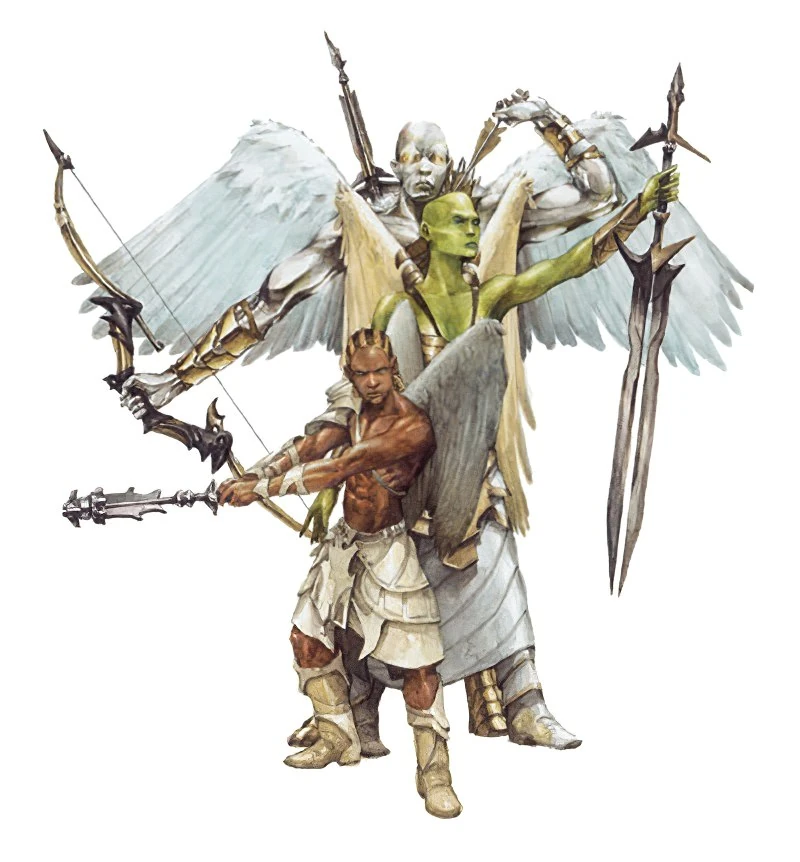

A trio of goodly beings.
Good was the opposite of evil, and was generally associated with honesty, charity, and sincerity.[1]
Description
As with evil, good was subjective and was defined differently by different societies and inhabitants. However, generally, those who were good often worried about their errors and would try to repair damage, if they had caused any. Inhabitants who focused on the pursuit of good, especially helping others, with no particular regard for law or chaos were known as neutral good.[1] Those who strived for the greater good, even if it meant being unorganized or radical, were known as chaotic good.[4] Good inhabitants who swore by law and order, particularly paladins, were known as lawful good.[1][5]
Some interpreted good inhabitants as those who practiced altruism, protection of life, and personal sacrifice.[7] Others interpreted good people as those who believed that protecting and helping those in need, or those who are too weak to act for themselves, was the right thing to do.[8]
Notable Goodly Creatures
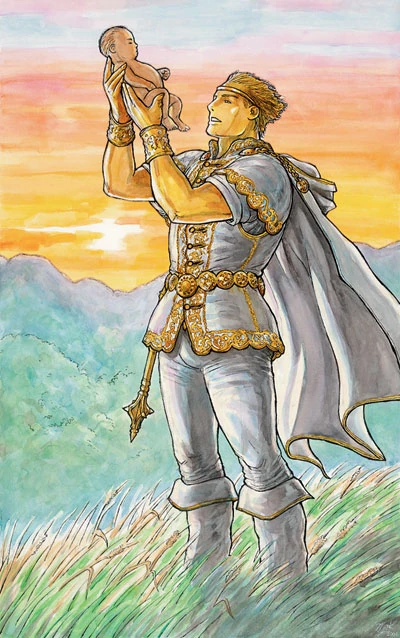

An avatar of Lathander, the goodly god of the dawn and renewal, holds a newborn.
- Archons were lawful good beings that protected those who were free of evil.[9]
- Celestials were being that were almost always good, whether they be lawful good, neutral good, or chaotic good.[10]
- Many types of elves tended towards being chaotic good, such as moon elves, who were very tolerant of other races.[11][12]
Notable Goodly Deities
- Tyr, a lawful good deity and the leader of the Triad.[13]
- Lathander, a neutral good deity of the dawn.[14][15]
- Selûne, a chaotic good deity who opposed her evil twin, Shar.[16]
Appendix
References
- ↑ 1.0 1.1 1.2 David "Zeb" Cook (April 1995). Player's Handbook 2nd edition (revised). (TSR, Inc.), p. 65. ISBN 0-7869-0329-5.
- ↑ BioWare (December 1998). Designed by James Ohlen. Baldur's Gate. Black Isle Studios.
- ↑ Kate Novak, Jeff Grubb (December 1997). Tymora's Luck. (TSR, Inc.). ISBN 0-7869-0726-6.
- ↑ David "Zeb" Cook (April 1995). Player's Handbook 2nd edition (revised). (TSR, Inc.), p. 66. ISBN 0-7869-0329-5.
- ↑ Mike Mearls, Jeremy Crawford (2014). Player's Handbook 5th edition. (Wizards of the Coast), p. 122. ISBN 978-0-7869-6560-1.
- ↑ Elaine Cunningham (April 2000). Elfshadow. (Wizards of the Coast), p. Epilogue. ISBN 0-7869-1660-5.
- ↑ Jonathan Tweet, Monte Cook, Skip Williams (July 2003). Player's Handbook v.3.5. (Wizards of the Coast), p. 104. ISBN 0-7869-2886-7.
- ↑ Rob Heinsoo, Andy Collins, James Wyatt (June 2008). Player's Handbook 4th edition. (Wizards of the Coast), p. 19. ISBN 0-7869-4867-1.
- ↑ Colin McComb, Dori Hein (February 1995). “Monstrous Supplement”. In Dori Hein ed. Planes of Law (TSR, Inc), p. 4. ISBN 0786900938.
- ↑ Skip Williams, Jonathan Tweet, Monte Cook (July 2003). Monster Manual v.3.5. (Wizards of the Coast), pp. 305–306, 308, 310. ISBN 0-7869-2893-X.
- ↑ Steve Kenson, et al. (November 2015). Sword Coast Adventurer's Guide. Edited by Kim Mohan. (Wizards of the Coast), pp. 105–106. ISBN 978-0-7869-6580-9.
- ↑ Mike Mearls, Jeremy Crawford (2014). Player's Handbook 5th edition. (Wizards of the Coast), pp. 23–24. ISBN 978-0-7869-6560-1.
- ↑ Julia Martin, Eric L. Boyd (March 1996). Faiths & Avatars. (TSR, Inc.), p. 169. ISBN 978-0786903849.
- ↑ Eric L. Boyd, Erik Mona (May 2002). Faiths and Pantheons. Edited by Gwendolyn F.M. Kestrel, et al. (Wizards of the Coast), pp. 37–38. ISBN 0-7869-2759-3.
- ↑ Ed Greenwood, Sean K. Reynolds, Skip Williams, Rob Heinsoo (June 2001). Forgotten Realms Campaign Setting 3rd edition. (Wizards of the Coast), pp. 234–235. ISBN 0-7869-1836-5.
- ↑ Steve Kenson, et al. (November 2015). Sword Coast Adventurer's Guide. Edited by Kim Mohan. (Wizards of the Coast), p. 21. ISBN 978-0-7869-6580-9.
Connections
Lawful good • Neutral good • Chaotic good
Lawful neutral • (True) neutral • Chaotic neutral
Lawful evil • Neutral evil • Chaotic evil
Lawful good • Good • Unaligned • Evil • Chaotic evil