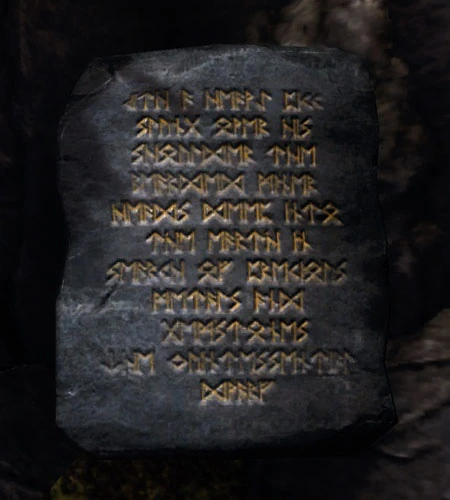
![A typical dwarven runestone, reading "This place is Dhurri's Bridge. Here 42 of the best warriors of the House of Helmung fell, to keep orcs from the Halls. We slew 608. [Day] 218, [year since the founding of the House] 377. , warrior of the "](https://static.wikia.nocookie.net/forgottenrealms/images/a/ae/Runestone_dwarf.png/revision/latest?cb=20120226154505)

A typical dwarven runestone, reading "This place is Dhurri's Bridge.
Here 42 of the best warriors of the House of Helmung fell,
to keep orcs from the Halls. We slew 608. [Day] 218,
[year since the founding of the House] 377.
Nain, warrior of the House of Helmung".[1]
Runestones were stone slabs with messages carved into them. These messages could be warnings, instructions, stories, or accounts of events. They varied in shape and size, depending on the creator and time they were made. Some runestones even had magic enchantments placed on them.[2]
History
The ancient civilization known as the Adamant Kingdom of Xothaer was home to numerous dwarven scholars. They recorded vast amounts of information on runestones. These records could still be found underneath the Cloud Peaks in various conditions, most shattered, in the 14th century DR.[4]
Around 1370 DR, the dwarves of Iltkazar were famous makers of runestones.[4]
Description
Runestones were large slabs of durable stone, usually about an inch thick. They had stories, instructions, and accounts of events carved into one or both of their faces. Runestones were sometimes carved with images or runes in relief, and thus could be used as seals or temporary path markers when pressed into wet mud. Although extremely rare, there were also runestones made of precious metals.[2]
Variations
Dwarven Runestones
Dwarven runestones were written in the Dethek script. They usually came in diamond or circular shapes. The text started at the edge and spiraled into the center, where an illustration (such as a clan symbol) was usually carved. Due to this, they were read from the outside edge to the center.[5]
Dwarven runestones were also used to mark graves, where an illustration of the dwarf in question would be carved into the center of the stone. Most dwarven runestones were used as maps and clues to hidden hordes of treasure. These stones were some of the most sought-after by greedy adventurers.[2]
Known Runestones
- Delzoun Runestone: This runestone was said to explain the whereabouts of the legendary Hammer of Thunderbolts.[2]
- Thunderholme Runestones: These runestones granted access to the ancient city of Thunderholme. Although some were recovered, many were still lost or hidden.[6]
- Spawn Wars Runestone: A fragment of this runestone was discovered several hundred years after it was made. It detailed the events of the Spawn Wars.[7]
- Rockfire Disaster Runestones: In 1374 DR, Cragwarden Samiel Tussin discovered two runestones southwest of Trythosford at Itzcala. The two stones described the events of the Rockfire Disaster of 987 DR.[8]
- Duergar Runestones: This series of runestones explained the history of Clan Duergar. They were discovered in 1383 DR by the crusaders of the Great Rift.[9]
- Axemarch Stone: This huge runestone stood 15 feet (4.6 meters) tall and 10 feet (3 meters) wide. It rested on the highest peak of the Marching Mountains, commemorating the dwarven king Aldir Velms leading the dwarves to the mountain range as well as the founding of High High Shanatar. The rune dated this event as "day 75 of the 492nd year of the founding of House Axemarch".[10]

The runestone outside Angelhead Mine.
- Angelhead Runestone: A runestone inscribed with writing of an unknown script and language was found lying amongst the rocks outside the main entrance of Angelhead Mine, wherein ancient ruins were found in 1479 DR.[11]
Appendix
References
- ↑ Ed Greenwood (October 1990). Dwarves Deep. (TSR, Inc.), p. inside cover. ISBN 0-88038-880-3.
- ↑ 2.0 2.1 2.2 2.3 Ed Greenwood (October 1990). Dwarves Deep. (TSR, Inc.), p. 11. ISBN 0-88038-880-3.
- ↑ Jeff Grubb and George MacDonald (April 1989). Curse of the Azure Bonds. (TSR, Inc.), p. 15. ISBN 978-0880386067.
- ↑ 4.0 4.1 Eric L. Boyd (November 1999). Drizzt Do'Urden's Guide to the Underdark. Edited by Jeff Quick. (TSR, Inc.), p. 103. ISBN 0-7869-1509-9.
- ↑ Ed Greenwood, Jeff Grubb (August 1987). “Cyclopedia of the Realms”. In Karen S. Martin ed. Forgotten Realms Campaign Set (TSR, Inc.), p. 9. ISBN 0-88038-472-7.
- ↑ Dale Donovan (January 1998). Cult of the Dragon. Edited by Julia Martin. (TSR, Inc.), p. 39. ISBN 0-7869-0709-6.
- ↑ Brian R. James, Ed Greenwood (September 2007). The Grand History of the Realms. Edited by Kim Mohan, Penny Williams. (Wizards of the Coast), p. 17. ISBN 978-0-7869-4731-7.
- ↑ Brian R. James, Ed Greenwood (September 2007). The Grand History of the Realms. Edited by Kim Mohan, Penny Williams. (Wizards of the Coast), p. 114. ISBN 978-0-7869-4731-7.
- ↑ Brian R. James, Ed Greenwood (September 2007). The Grand History of the Realms. Edited by Kim Mohan, Penny Williams. (Wizards of the Coast), p. 159. ISBN 978-0-7869-4731-7.
- ↑ Steven E. Schend (August 1997). “Book One: Tethyr”. In Roger E. Moore ed. Lands of Intrigue (TSR, Inc.), p. 21. ISBN 0-7869-0697-9.
- ↑ Cryptic Studios (June 2013). Neverwinter. Perfect World Entertainment.